OIG Report: Public Defense System is Broken, Expensive, and Resistant to Oversight
Fiscal Accountability and Oversight Not Inconsistent with Right to Counsel
The Office of the Inspector General (OIG) today released its report, An Analysis of Indigent Defense in Massachusetts, as mandated by Section 82 of Chapter 14 of the Acts of 2025.
“The Commonwealth’s public defense system is broken, expensive, and is resistant to oversight. Systemic issues such as how indigency is determined, ensuring CPCS staff attorneys carry the required caseload, and changing the fee structure for bar advocates must be addressed so the Commonwealth can sustainably provide for indigent defendants’ Sixth Amendment right to counsel,” Inspector General Jeffrey S. Shapiro said. “The findings and recommendations in this report need not conflict with the right to counsel. Indeed, an indigent defense system is a use of public dollars and is subject to the same scrutiny and oversight as any other public expenditure.”
The OIG found that CPCS attorneys work the lowest number of cases of any statewide public defender system for which the OIG could find comparable data, including Connecticut, New Hampshire, and Vermont, and fail to handle twenty percent of the caseload as required by the Legislature. Among the comparable statewide systems, the OIG found that Massachusetts was the most expensive system on a cost-per-new-case basis. In fact, unless CPCS staff attorneys increase their caseload, it would be more cost effective for the Commonwealth to continue to rely on bar advocates (and even to further increase bar advocate fees) than to hire additional CPCS staff attorneys.
The OIG also found that the difference between the number of cases that the Legislature expects CPCS to assign to its staff attorneys, and the number of cases staff attorneys actually work, is greater than the number of defendants who proceeded to Lavallee protocol hearings following the May 2025 bar advocate work stoppage.
“Perhaps our most troubling finding is that had CPCS staff attorneys carried the required 20 percent caseload, the 2,227 Lavallee hearings that resulted in nearly 1,689 dismissed cases and 213 defendants released from custody without bail could have been avoided,” IG Shapiro said.
It is important to note that the Chief Counsel for CPCS has previously stated that calls for CPCS staff attorneys to take on cases above its internal caseload expectations would “undermine the integrity of the justice system.” The OIG found that the integrity of the justice system has already been undermined by the repeated cycle of bar advocate work stoppages, the refusal of CPCS to assign additional cases to its staff attorneys, and the implementation of the Lavallee protocol, which has resulted in thousands of hearings to dismiss cases and hundreds of defendants being released from custody.
The OIG also found that Massachusetts is the only jurisdiction that limits the total number of hours that bar advocates can bill in a year across all cases. All other states that cap private counsel fees do so by individual case based on case type.
“Under the current fee structure, bar advocates are only limited in the total amount of hours they can bill annually. It is not tied to the number of cases they work nor the type of case they handle,” IG Shapiro said. “Setting a fee cap based on case type would incentivize bar advocates to take additional cases, rather than bill more hours on the cases they have been assigned.”
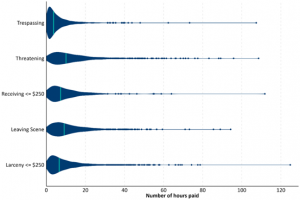
The figure below shows a grouping of all individual bills for each offense by number of hours paid. The vertical line indicates the median number of hours. The shape of each grouping shows a large number of bills with only a few hours, followed by a long “tail” that indicates a relatively small number of bills with a high number of hours. For the offense categories examined, the median number of hours paid ranged from approximately 3.7 to 10.1 hours, while maximum hours ranged from approximately 94.3 to 124.8 hours.
###